What I've found after years of research and studying Bruno's destructive behaviours..
I did everything the trainers told me to do first, and none of it worked. So I stopped treating the chewing and the mess as bad behaviour, and started treating it as what it actually is.
I thought he was just being bad
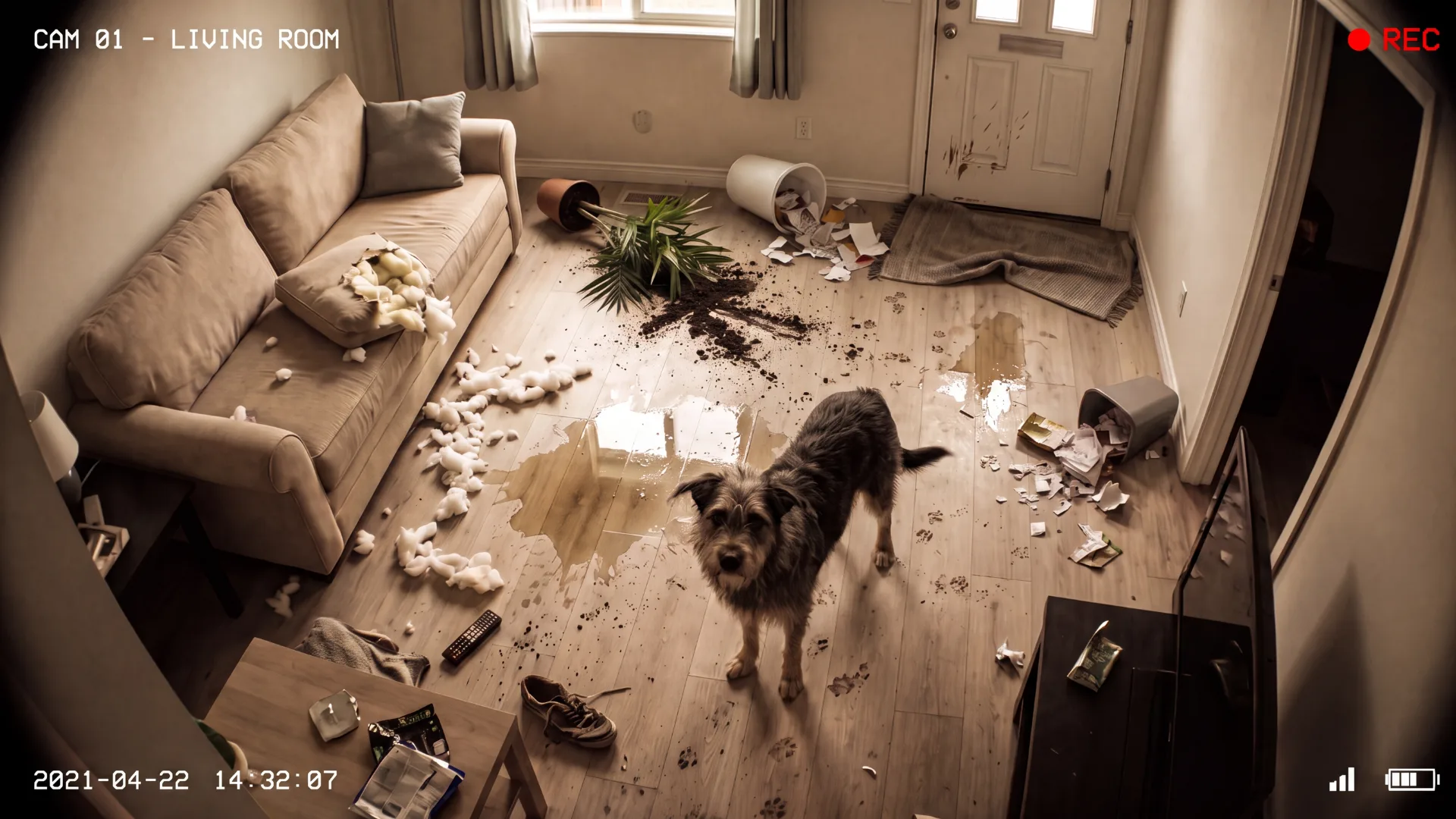
Bruno is a rescue mongrel, no idea what's actually in him, and for the first two years I genuinely thought I had a badly behaved dog.
I came home to a door frame chewed down to the raw wood. To the stuffing pulled out of a cushion and spread down the hall like snow. Once to a puddle by the mat, from a dog who had been house-trained for eighteen months.
And around the wreckage, all the rest of it. He barked at the door, the post, the neighbours, the idea of the neighbours. He paced. He followed me room to room and never fully lay down. The second I picked up my keys he came apart.
So I did what you do. I bought the training books. I did the crate work. I did the calm, unemotional departures the internet swears by. I tried the treats from the pet store, the plug-in diffuser, the drops in his water.
Some of it helped a little, for a while. None of it touched the thing underneath.
What finally landed, and I'm embarrassed it took two years, was a vet saying it almost in passing: he's not being bad, he's frightened, and he can't come down from it.
That reframed everything. I hadn't been failing at discipline. I'd been disciplining a panic attack.
I went looking for what actually works
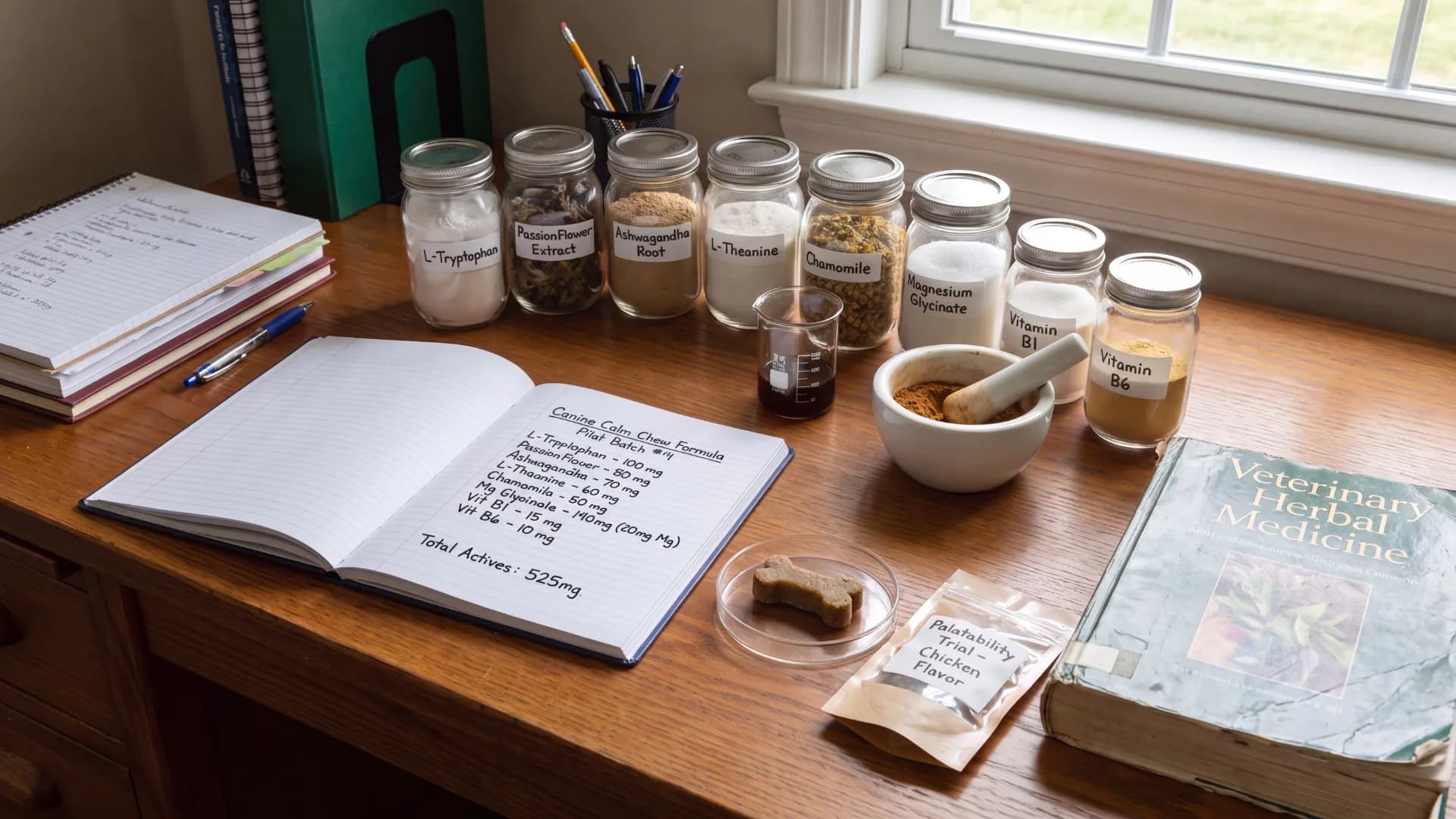
I stopped reading training blogs and started reading the underlying work. The veterinary behaviour literature. The trials on L-Theanine in dogs. The human research on adaptogens and cortisol, and then the canine work that followed it.
I read labels. Every label in the pet store, one weekend, with my co-founder. That weekend is the reason Wouflab exists, and it was genuinely depressing.
Here's what I expected to find: that calming supplements were mostly placebo, and anxious dogs were just anxious dogs.
What I actually found was the opposite. The ingredients worked. They worked in published studies at published doses. What the products in the aisle were doing was putting those same ingredients on the label at a fraction of the dose that had been tested.
A long ingredient list, printed small, at maybe 140 mg of actives total. Enough to name the ingredient. Nowhere near enough to do what the study did.
The dogs weren't failing. The doses were. And underneath that sat three things modern life does to a dog that nobody had told me about.
What modern life quietly does to a dog

1 – We leave them alone in a way no dog was built for
Dogs were bred, for thousands of years, to be beside us. Working next to us, sleeping in the same room, never more than a field away.
Then we invented the eight-hour day and the closed front door, and asked an animal with no concept of “back at six” to sit quietly with that.
For a confident dog it's a nap. For a dog like Bruno it is, every single time, the person he depends on vanishing with no explanation and no end date.
This isn't a character flaw and it isn't spite. It's a description of a mismatch. And you cannot train it away in the ten minutes before you leave.

2 – They never get to come down
Watch an anxious dog for a full day. Not the dramatic moments, the quiet ones.
Watch the ears track a car three streets away. Watch him lie down and get up again. Watch him never quite get to the bottom of a breath.
A stress response is supposed to spike and then clear. Something happens, cortisol rises, the thing passes, the body flushes it out and returns to baseline.
In a home with a doorbell, a street, a phone, a delivery van and a family, the spikes never stop arriving. Cortisol never gets the quiet hour it needs to fall.
So the baseline itself creeps up. And a dog living on a raised baseline isn't reacting badly to the doorbell, he's reacting from a body that was already braced.
That is the part the treats never touch. They aim at the moment. The problem is the baseline.
3 – We're sold two options, and both are wrong
When you finally go looking for help, the market hands you exactly two things.
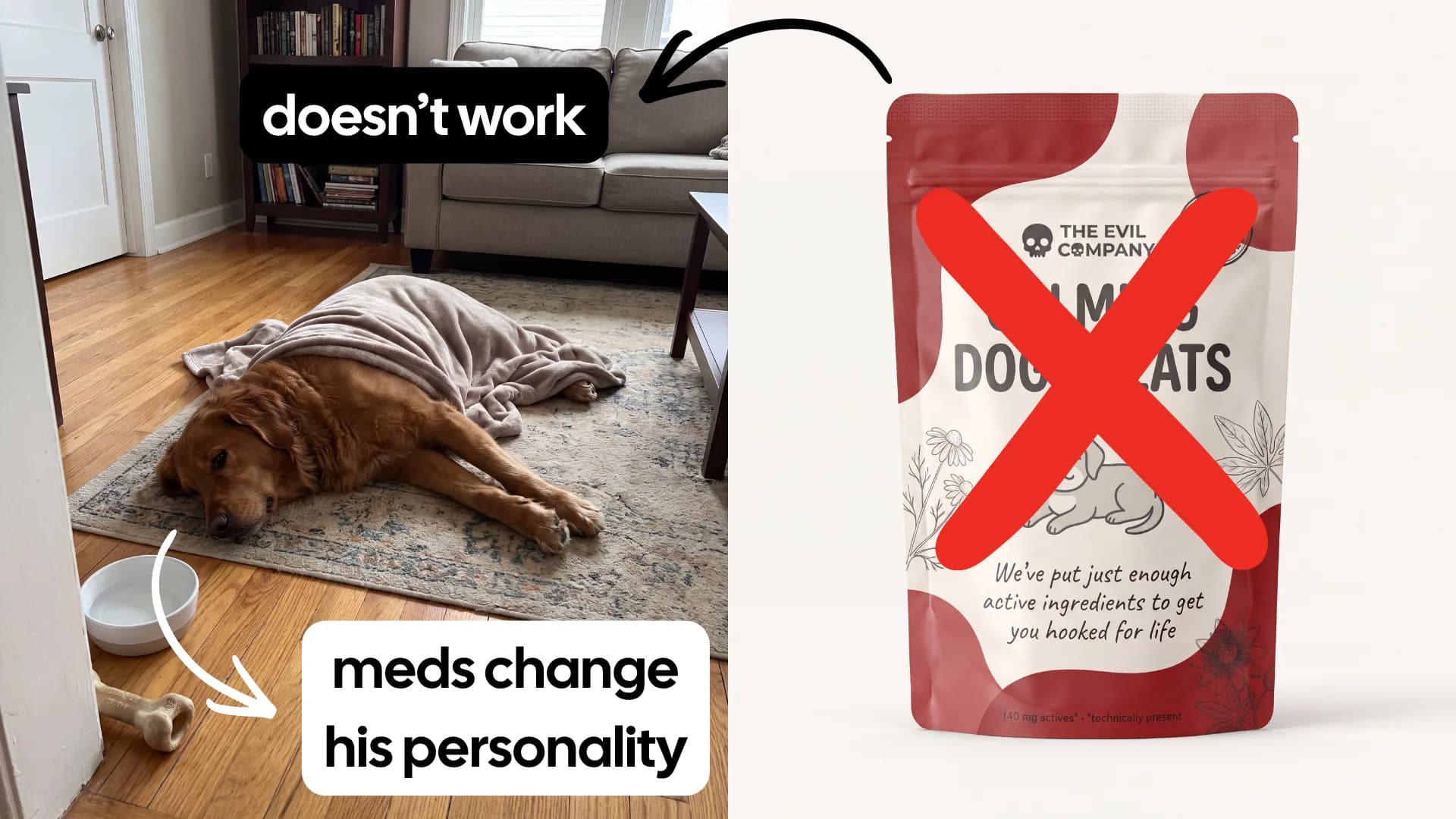
On one side, the sledgehammer. A sedative that works by dimming everything, until your dog is groggy on the floor and the spark is gone. That's not calm. That's just off.
On the other, the snack. A bag of treats with a beautiful label and a dose too small to do anything, sold to you monthly, forever.
Notice what both have in common. Neither of them ever ends. One keeps your dog switched off and one keeps him exactly as anxious as he was, and both keep you paying.
The option nobody was selling me was the obvious one: calm him down today, and fix the baseline underneath, so that in a few months he doesn't need the chew at all.
The system that actually works, in three timed layers
By the end of that year I'd narrowed it to three jobs that have to happen at three different speeds. Miss one and you get the products already in the aisle.

The fast layer — within the hour
L-Theanine and passionflower. The first nudges the brain into the same alpha-wave state we reach in deep meditation. The second targets the specific emotional panic of being left.
Give it thirty to forty-five minutes before the thing you know is coming. The door, the storm, the fireworks.
The goal is a dog who is visibly calmer within the hour, and still awake, still focused, still able to play.

The steadying layer — over weeks
L-Tryptophan, Vitamin B6, magnesium glycinate, chamomile, Vitamin B1. This is the unglamorous half nobody puts on the front of the bag.
Tryptophan becomes serotonin, but only if B6 is there to do the conversion. Stress burns through magnesium and leaves a dog shaky, so you top it back up. An anxious gut feeds an anxious dog, so chamomile breaks that loop.
The goal is a dog whose moods stop swinging, whose stomach settles, who startles and then actually recovers.

The reset layer — over two to three months
Ashwagandha. The long game, and the reason the whole thing has an end date.
It's an adaptogen that pulls down the chronically high cortisol sitting behind the pacing, the panting and the can't-switch-off vigilance. It works on the raised baseline, not the moment.
The goal is a dog who is genuinely more resilient to fear, rather than medicated through it. Which means, eventually, a dog you can take off the chews.
The dog I have now
Bruno still barks at the post. I want to be honest about that, because I don't think you should trust anyone who tells you their dog became a different animal.
What changed is everything around it. He barks, and then he stops. He hears the keys and he lifts his head instead of coming apart. He sleeps through the middle of the day, in a heap, properly.
The door frame has been intact for years now.
And the difference between year two and year four wasn't luck, and it wasn't training. It was giving him something that worked fast enough to break the panic, at a dose high enough to matter, every day, for long enough to move the baseline underneath.
Why we built Calm & Comfort
We started Wouflab because the supplements aisle made us sad. Two founders, three dogs, and that one weekend reading every label.
Calm & Comfort is the first thing we built, because Bruno is the reason there's a company at all.
It's 525 mg of actives per chew, against roughly 140 mg in the competitor chews we weighed up. Eight actives, chosen to work together in the three layers above, each at a level meant to actually do something. We publish the exact milligrams. If a brand hides a dose, assume there's a reason.
And it is deliberately built to end. Give one a day for two to three months, and the point is that you get to stop. No lifetime payments, no barely-there chew he leans on forever.
That is a strange thing to build a business on, and we know it. We'd rather make six products properly than sixty things badly.
What the reset looks like
One soft chew a day. The same three layers every day, calm, steady, reset, working on three different clocks.
First relief
Give it 30 to 45 minutes before the stress hits. The panic softens the same day. Non-drowsy, so he's calmer, not knocked out.
The moods settle
Barking, pacing and accidents get less frequent and less intense. He startles less, and recovers faster when he does.
Then off the chews
Calm becomes his default rather than something he gets from a chew. Once the new baseline holds, you start tapering him off.
Timings reflect results from independent clinical studies on the actives. We use the same doses, and in some cases higher.
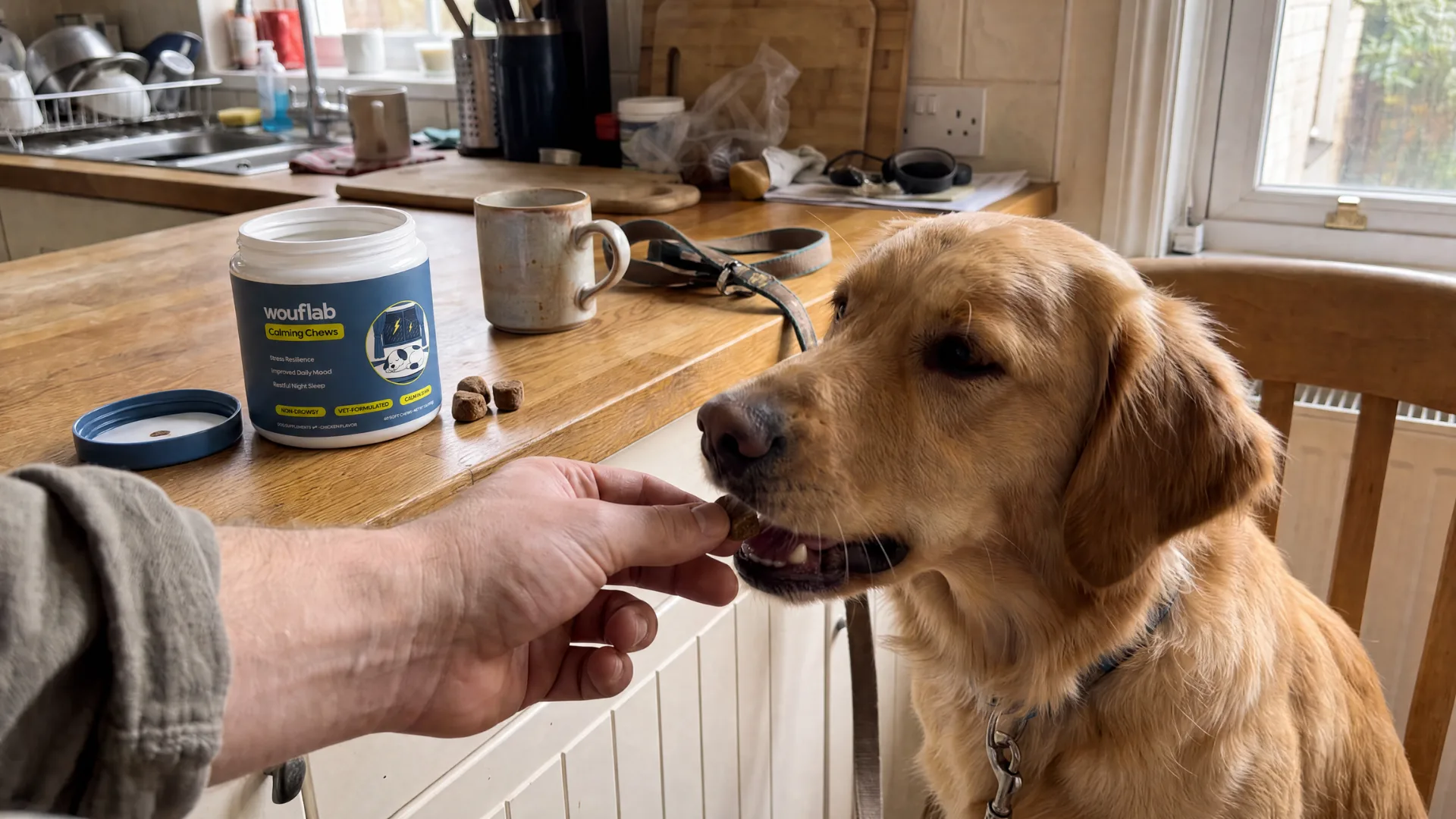
Thirty chews to a jar, one a day, sized to your dog's weight. Most dogs think it's a treat, which spares you the dropper fight.
From the owners who've done it
Unedited messages, shared with permission.
The upstairs neighbor left a note about the howling. I was mortified. Three weeks on the chews and the crying when I leave has basically stopped, I recorded him napping on the cam. No note this time.
ok i wasn't going to write this but we tried a prescription first and hated it, he was a zombie, wouldn't even chase his ball. this is nothing like that. he's calm but still my goofy ball-obsessed idiot. that's the whole thing i wanted, i didn't want a different dog i wanted my dog minus the panic
a month in. house intact. nerves intact. it was anxiety not spite, i get that now
Honest review: day one it just took the edge off and I nearly wrote it off. The real change was around week six. He's a worrier by nature and he's just… softer now. Doesn't lose his mind at the doorbell. Stick with it.
What you'd otherwise spend on this
For comparison, this is what the alternatives cost, priced in the open market. I priced most of them personally.
- A veterinary behaviourist consult$150–400
- Behavioural meds + the vet visits around them$200–600 / yr
- Daycare or a walker to cover the alone time$1,200–3,000 / yr
- Calming treats that don't move the needle$25–40 / mo, forever
- The full 2–3 month reset · Calm & Comfortfrom $79
And then it stops. That's the difference. Everything above this line is a subscription to the problem.
Free shipping over $50, and sixty days to change your mind
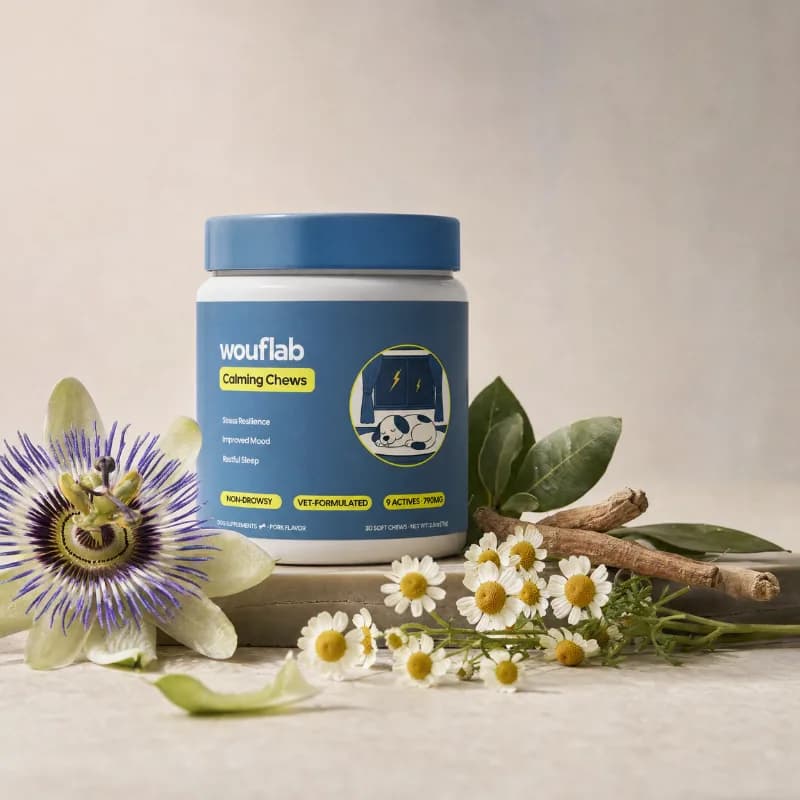
A single month is $35 and it will show you whether the fast layer works on your dog. Most people feel that part in the first week.
But the reset is the two-to-three month piece, and that's the part worth buying. The two and three month supplies are cheaper per day, they clear free shipping on their own, and they cover the actual length of the job.
Price depends on your dog's weight, because a bigger dog eats more chews. You pick the band on the next page.
Choose your supplyIf it doesn't work, send it back
Sixty days. Give it a proper run, ideally the full few weeks it takes to settle a baseline, or give it a fortnight and decide it isn't for you.
If at any point in those sixty days your dog isn't genuinely calmer, email us at contact@wouflab.com and we'll refund you. No form, no questions.
Even if the jar is open. Obviously it's open, that's the only way you'd know.
Questions I get a lot
The ones that come up before every order.
Will it sedate my dog or change their personality?
No, and that's the whole point.
It lowers the stress chemistry without blunting the dog. It's built around non-drowsy actives like L-Theanine, so they relax and settle but stay awake, playful and completely themselves.
If you've tried a prescription sedative and hated the zombie effect, this is the opposite.
How fast does it work?
Two speeds. Most dogs feel the edge come off within about 30 to 60 minutes of a chew, that's the L-Theanine and passionflower.
The deeper change is slower. Adaptogens like ashwagandha rebuild a calmer baseline over two to three months of daily use.
Give it before a known stressor for fast relief, and keep it daily for the lasting calm.
My dog panics when I leave. Will this help?
That's one of the things it's built for.
Passionflower targets the emotional panic of separation, while the daily formula lowers the background stress that makes it worse.
Pair a chew about forty-five minutes before you leave with a little training, and most owners see the howling, scratching and accidents ease over a few weeks.
What makes it different from cheap calming treats?
Dose and design. Most treats sprinkle a few milligrams of a long ingredient list so the label looks impressive, and some of those ingredients even work against each other.
We pack 525 mg of eight actives into every chew, each at a level meant to do something, chosen to work together in timed layers.
It's a supplement, not a snack.
Is it safe to give every day, or alongside medication?
It's formulated for daily use in dogs three months and older. Daily is actually how you get the long-term benefit.
If your dog is pregnant, nursing, or on medication, especially other sedatives or behavioural meds, check with your vet before starting.
What if it doesn't work?
You've got sixty days. Give it a proper run, ideally the full few weeks it takes to settle a baseline.
If your dog isn't calmer, send it back for a full refund. Even if the jar's open.
Give them a calmer day
He isn't being bad. He's frightened, and he can't come down from it on his own. That part is fixable, and it has an end date.
Get Calm & ComfortFrom $35· Free shipping over $50 · 60-day trial
Calm & Comfort is a supplement for dogs three months and older, and is not a substitute for veterinary care. It is not intended to diagnose, treat, cure or prevent any disease. Talk to your vet before starting any supplement, especially if your dog is pregnant, nursing, or taking medication, and particularly alongside other sedatives or behavioural medication. Severe or sudden-onset anxiety can have a medical cause and should be seen by a vet. Individual results vary.